2025 KIDS COUNT
DOWNLOAD THE 2025 KIDS COUNT in COLORADO! DATA BOOK!
- Download the 2025 KIDS COUNT in Colorado! Data Book in Spanish.
- Download the KIDS COUNT in Colorado! highlights PDF.
- Watch a recording of the KIDS COUNT in Colorado! Data Book release.
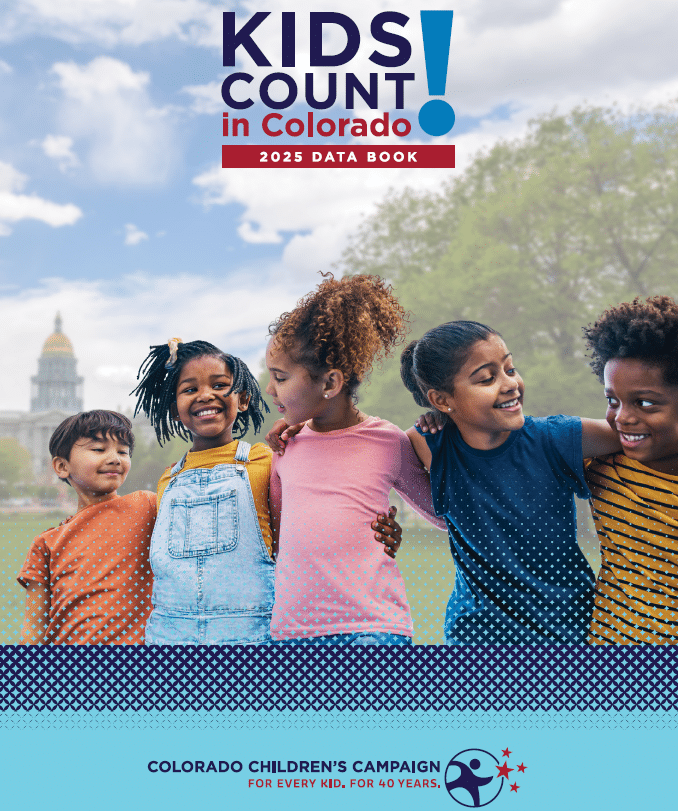
The 2025 edition of the KIDS COUNT in Colorado! Data Book provides the most up-to-date data on issues affecting kids and families and offers policy recommendations for our state to move forward in a more equitable and effective manner. The report tracks child well-being at the state and county levels in economic security, health, early childhood, and K-12 education.
Five years after the COVID-19 pandemic, this year's report finds some promising trends in mental health, absenteeism, and graduation rates. We can see the positive results of our state's efforts to invest in early childhood and in families' economic security. At the same time, too many families are struggling with the cost of living - and too many children are still struggling to meet expectations in reading and math.
This report also includes data profiles for each Colorado county.
Find data for your county below!
KIDS COUNT in Colorado! is part of the Annie E. Casey Foundation’s national KIDS COUNT project. KIDS COUNT serves as an important source of quality, unbiased information on children and families for decision-makers and child advocates.

2024 KIDS COUNT
A recording of our release event is now available. Watch here!
The KIDS COUNT Report is now available in Spanish. Download here!
The 2024 edition of KIDS COUNT in Colorado! provides the most up-to-date data on issues affecting kids and families and offers policy recommendations for our state to move forward in a more equitable and effective manner. The report tracks child well-being at the state and county levels in family economic prosperity, child and family health, early childhood learning and development, and youth success.
The 31st annual KIDS COUNT in Colorado! report highlights the impact of the end of policies that supported kids’ and families’ well-being during the pandemic on families’ well-being, including on access to housing, health care, child poverty, and more. It also captures trends in school climate, student performance and graduation rates, early childhood, and other issues.
This report also includes data profiles for each Colorado county.
Find data for your county below!
KIDS COUNT in Colorado! is part of the Annie E. Casey Foundation’s national KIDS COUNT project. KIDS COUNT serves as an important source of quality, unbiased information on children and families for decision-makers and child advocates.
2024 KC Report 8.12.24 LOW RES2023 KIDS COUNT
Building Understanding: Youth Mental Health and Well-Being in Colorado, the 2023 edition of KIDS COUNT in Colorado!, spotlights trends in youth mental health and access to care. It includes an overview of the most recent data on the topic and offers recommendations for policy action to promote youth mental health in the years ahead.
The 30th annual KIDS COUNT in Colorado! report also tracks the well-being of Colorado children statewide and at the county level in the areas of family economic prosperity, child and family health, early childhood learning and development, and youth success.
The report highlights promising programs and efforts to support youth mental health across the state. It also features insights from young people as part of a partnership with the YouthScan Project, a statewide digital initiative that puts youth voices front and center in the decisions that impact their lives.
KIDS COUNT in Colorado! is part of the Annie E. Casey Foundation’s national KIDS COUNT project. KIDS COUNT serves as an important source of quality, unbiased information on children and families for decision-makers and child advocates.
2022 KIDS COUNT
KIDS COUNT in Colorado!: A Pause on Progress: The Impacts of the Pandemic on Colorado’s Kids
The 2022 KIDS COUNT in Colorado! report reveals the momentous loss experienced by children and families across the state during the first two years of the COVID-19 pandemic. It illustrates the pandemic’s continued, far-reaching effects on Colorado kids – from difficulty accessing health care, child care, early learning opportunities, and K-12 education; to ongoing housing instability and other economic challenges. Among Colorado households with children, about half reported a loss of household income since the pandemic began, and one-third reported difficulty paying for usual household expenses, including medical care or food.
Even amid the hardships of the pandemic, however, it is clear that policy change can make an enormous difference in the lives of children and families. The 2022 report offers policy recommendations that emphasize the need to increase public investment in programs that support the health and well-being of children across the state. Recommendations include investing in income support for families; expanding access to behavioral, mental, and physical health services; and investing in sustainable, adequate support for children’s early learning and development. The report also highlights policy changes enacted since March 2020 that helped shield kids and families from the pandemic and accompanying economic downturn.
The annual KIDS COUNT in Colorado! report tracks the well-being of Colorado children statewide and at the county level. The 29th annual report includes data and research on kids in the areas of health, early childhood, K-12 education, and family economic security. The report is a complement to the national KIDS COUNT Data Book produced by the Annie E. Casey Foundation, which was released on Aug. 8.
2022 KC Final Low Res2021 KIDS COUNT
KIDS COUNT in Colorado!: At a Tipping Point: Building Stronger Systems for Colorado Kids in the Aftermath of COVID-19
The 2021 KIDS COUNT in Colorado! report examines how children fared during the first year of the COVID-19 crisis. The data included in the report illustrate the pandemic’s far-reaching effects on Colorado kids, from increased housing instability and hunger to difficulty accessing health care, child care, preschool and K-12 education. At some points during the pandemic, as many as one in five Colorado households with children reported little or no confidence they would be able to make their next housing payment on time. The state also saw steep declines in the number of young children enrolled in services such as preschool or Early Intervention.
The KIDS COUNT report also offers a snapshot of trends from before the pandemic. Even prior to the COVID-19 crisis, Colorado’s historic progress on kids’ health insurance coverage was beginning to erode. Between 2018 and 2019, the number of Colorado children without health coverage increased by 10,000 kids, leaving 73,000 without health coverage as the world entered the worst public health crisis in a century. Given the high rates of unemployment driven by the pandemic’s economic impact, Colorado could see even more damage to its progress toward getting all kids covered in the years ahead.
The report tracks the well-being of Colorado children statewide and at the county level. The 28th annual report includes data and research on kids in the areas of health, early childhood, K-12 education, and family economic security. The report is a complement to the national KIDS COUNT Data Book produced by the Annie E. Casey Foundation, which was released in June.
2021 KC Final low res 8.18.212020 KIDS COUNT
KIDS COUNT in Colorado!: Creating a Path Forward for Colorado’s Kids
The 2020 edition of KIDS COUNT in Colorado! examines the current state of preschool in Colorado—the need, the access, and the opportunity—as lawmakers consider expanding access to the Colorado Preschool Program and Gov. Jared Polis calls for improved access to quality preschool statewide.
This 27th edition of the annual focus on well-being of Colorado children and families provides a foundation of data and research to guide the policy making of state and local leaders. This year’s report, Creating a Path Forward for Colorado’s Kids, explores what a significant expansion in preschool access would mean to Colorado’s young children. Researchers examined barriers to quality early learning faced by kids with the most obstacles to learning—and how an expansion toward a universal system should put them first.
The report is produced by the Colorado Children’s Campaign as part of the national KIDS COUNT project. It includes data for every county in Colorado on child demographics, economic security, health, early childhood and K-12 education.
NOTE: The report was finalized before the onset of the COVID-19 pandemic and does not reflect changes in trends since the crisis began. See our KidsFlash blog for the latest analysis of post-pandemic data and research as they become available.
2020 Kids Count final low res 4.15.202019 KIDS COUNT
Making Every Kid Count in the U.S. Census
The 2020 Census risks undercounting thousands of young Colorado children, depriving communities of federal funding and political representation for the next decade. Children under age 5 are more likely to be missed by the census than any other age group, with children of color, non-English speakers, and kids living in high poverty communities at highest risk.
The 2010 Census undercounted Colorado kids under age 5 by 5 percent, and the undercount of young kids in the 2020 Census could be even worse given fears about data privacy and confidentiality, according to the 2019 edition of KIDS COUNT in Colorado!, an annual county-by-county report on child well-being. Failing to count Coloradans will put billions of federal dollars and representation in Congress at stake in the decade following the nationwide count of every person. In 2015, Colorado received more than $2 billion in census-guided federal funding for kids’ programs alone, including Medicaid, the Children’s Health Insurance Program and Head Start, among others.
The annual KIDS COUNT in Colorado! report tracks the well-being of Colorado children statewide and at the county level. The 26th annual report includes data and research on kids in the areas of demographics, health, early childhood, K-12 education and family economic security. The report is a complement to the national KIDS COUNT Data Book produced by the Annie E. Casey Foundation.
2019 KidsCount 9-4-19 Low Res2018 KIDS COUNT
25 Years of Ensuring Every Kid Counts
The 2018 edition of KIDS COUNT in Colorado! examines child well-being trends across the 25-year history of the comprehensive report on child well-being. From plummeting infant mortality rates to a concerning rise in teen suicides, the anniversary edition of the KIDS COUNT report offers a rare long-term look at how Colorado kids are faring—and what policymakers need to be aware of as they work to improve Colorado for the next 25 years.
The 25th edition of the KIDS COUNT report, “25 Years of Ensuring Every Kid Counts,” is produced by the Colorado Children’s Campaign as part of the national KIDS COUNT project. It includes data for every county in Colorado on child demographics, economic security, health, early childhood and K-12 education.
For more information on the data in this year’s KIDS COUNT report, including a report of key findings, please reach out to Sarah Hughes, Vice President, Research Initiatives, at sarah@coloradokids.org.
2017 KIDS COUNT
Elevating Equity: A Vibrant Future for All Colorado Kids
We all want our kids to inherit a bright and vibrant future. Whether our family has been here for generations or we’re brand new Coloradans, we all hope to leave our children a better world than the one we inherited.
If we want this future for our own children, we must work to make it a reality for all Colorado children. Too many Colorado kids face barriers to opportunity because of their race or ethnicity.
Data and research show that many Colorado kids face challenges such as attending a high-poverty school, lacking access to culturally relevant health or children care, struggling to find affordable housing and more. These trends often fall along racial and ethnic lines.
This year’s KIDS COUNT report delves into disparities in child well-being based on race and ethnicity to show us where we can, and must, do better at creating equitable opportunities for children.
Although we have been shaped by the past, we are not powerless in changing the future. In fact, this report shows us that intentional public policy decisions created these disparities—and they can end them.
For more information about the OMNI Institute-led community dialogue sessions that informed this year’s KIDS COUNT report, including a report of key findings, please reach out to Sarah Hughes, Colorado Children’s Campaign Research Director, at sarah@coloradokids.org.
2016 KIDS COUNT
KIDS COUNT in Colorado! is an annual publication of the Children’s Campaign, providing state- and county-level data on child well-being factors including child health, education, and economic status. Since its first release in 1993, KIDS COUNT in Colorado! has become the most trusted source for data and information on Colorado children and is relied upon by lawmakers, community leaders, and child advocates to inform policy debates and community discussions on issues impacting kids.
The Children’s Campaign released the 2016 report on March 28, 2016 at the Colorado State Capitol with Gov. John Hickenlooper.
Futures in the Balance
Imagine the complex factors that influence a child’s opportunities in life set on either side of an old-fashioned scale. The teeter-totter of each child’s scale can be influenced by parents, schools, communities and, in many ways, public policies. Positive experiences and influences—a loving and nurturing caregiver, a safe and stable place to call home, or high-quality educational opportunities—are placed on one side. These factors help tip the scale in the positive direction and make it more likely that a child will thrive. Negative experiences—abuse, neglect, violence, poverty, or racism—push the scale in the negative direction. For some children, the weights on the negative side are so heavy that we need to work harder to balance them out.
This year’s KIDS COUNT in Colorado! report shows some developments that will help tip the scale toward the positive for many children: More Colorado children are covered by health insurance than at any point in recent history. Fewer children are living with the daily stresses of poverty. More children have access to full-day kindergarten and preschool programs.
But for too many of our state’s children, the odds remain weighted against them. Despite the decline in our state’s child poverty rate, more than 190,000 Colorado children still lived in poverty in 2014, with 82,000 living in extreme poverty. Colorado school districts identified nearly 25,000 students who were experiencing homelessness. More than 240,000 children lived in households that were uncertain about whether they would have enough food for their families.
When we ensure children get what they need to learn and grow, we are not only outweighing past negative experiences, but ensuring they are able to handle future challenges as well. Our goal as a state must be to ensure that every child has strong and stable support during their earliest years, access to affordable health care and healthy foods, and a high-quality education. By stacking the scale with these positive factors, we help give every Colorado child the best possible chance of success.
Special thanks to our generous KIDS COUNT in Colorado! sponsors – the Annie E. Casey Foundation, Jay & Rose Phillips Family Foundation of Colorado, and Adolph Coors Foundation.
2016 KIDS COUNT in Colorado!